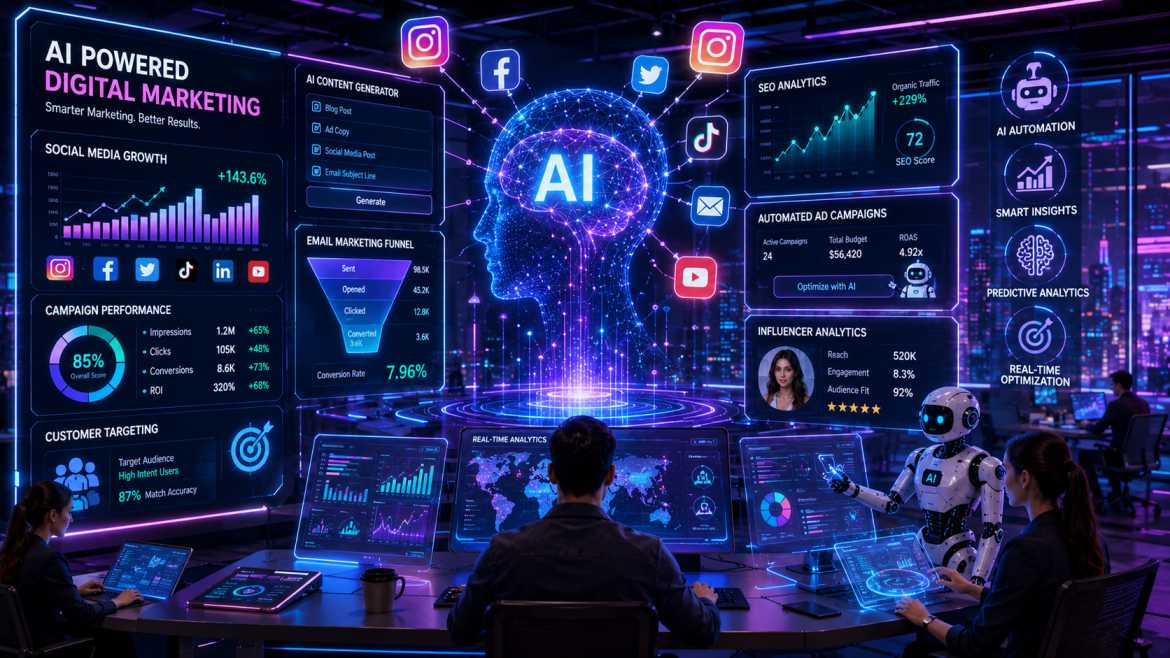
Digital marketing has changed dramatically over the past decade. Businesses no longer rely only on newspaper ads, television commercials, or traditional billboards to reach customers. Today, brands compete for attention across search engines, social media platforms, email campaigns, websites, and video content. As the online world becomes more crowded, companies are constantly searching for smarter ways to connect with audiences and improve marketing performance.
This is where artificial intelligence has become a game changer.
In 2026, AI is transforming digital marketing faster than ever before. Businesses of all sizes are using AI-powered tools to automate campaigns, analyze customer behavior, create personalized content, optimize advertisements, and improve customer engagement. What once required large marketing teams and countless hours of manual work can now be completed much faster with AI systems.
One of the biggest reasons AI is becoming so important is because modern marketing generates enormous amounts of data. Every click, search, purchase, and interaction provides valuable information about customer behavior. AI helps businesses process this data quickly and turn it into useful insights that improve marketing strategies.
At the same time, customer expectations have changed. People want personalized experiences, faster communication, and relevant recommendations. AI helps brands deliver these experiences at a scale that would be difficult using traditional methods alone.
From social media advertising and SEO to email marketing and content creation, artificial intelligence is reshaping nearly every part of the digital marketing industry.
In this article, we will explore how AI is revolutionizing digital marketing, the technologies businesses are using, the benefits and challenges of AI-powered marketing, and what the future may look like for brands and creators in the AI era.
The Evolution of Digital Marketing
Digital marketing has evolved rapidly since the early internet era.
Years ago, online marketing focused mainly on:
- Basic banner ads
- Email campaigns
- Simple websites
- Manual SEO strategies
As technology improved, businesses gained access to:
- Social media marketing
- Data analytics
- Search engine advertising
- Influencer campaigns
- Video marketing
Today, AI is taking digital marketing to an entirely new level by automating decision-making and improving personalization.
Modern AI systems can:
- Predict customer behavior
- Generate content
- Optimize ad campaigns
- Analyze data instantly
- Personalize user experiences
This transformation is helping businesses market more efficiently while improving customer engagement.
Why Businesses Are Using AI in Marketing
Companies are investing heavily in AI because marketing has become more competitive and data-driven.
1. Growing Competition
Millions of businesses compete online for customer attention.
AI helps brands optimize campaigns and stand out more effectively.
2. Massive Amounts of Data
Modern marketing generates huge amounts of customer data.
AI can analyze this information much faster than humans.
3. Demand for Personalization
Customers expect tailored recommendations and personalized experiences.
AI helps businesses understand user preferences and behavior.
4. Need for Faster Content Production
Brands constantly create:
- Blog posts
- Social media content
- Videos
- Emails
- Advertisements
AI speeds up content creation significantly.
AI-Powered Content Creation
Content marketing is one of the biggest areas being transformed by AI.
Businesses use AI tools to create:
- Articles
- Product descriptions
- Ad copy
- Email campaigns
- Social media captions
- Video scripts
Why AI Content Tools Are Popular
Creating large amounts of content manually takes time and money.
AI helps businesses:
- Generate ideas faster
- Improve consistency
- Scale content production
Human Creativity Still Matters
Although AI speeds up writing, human editing and creativity remain important for originality and emotional connection.
The best results often come from combining AI assistance with human storytelling.
AI and Search Engine Optimization (SEO)
SEO remains one of the most important parts of digital marketing.
AI is improving SEO by helping marketers:
- Analyze keywords
- Optimize content
- Understand search intent
- Track rankings
- Study competitors
AI SEO Tools Can:
- Suggest keywords
- Improve readability
- Optimize headlines
- Generate meta descriptions
- Analyze search trends
Why It Matters
Search engines are becoming smarter.
AI helps marketers create content that matches user intent more effectively.
Personalized Marketing Experiences
One of AI’s biggest strengths is personalization.
Modern consumers expect brands to understand their preferences.
AI systems analyze:
- Browsing history
- Purchase behavior
- Search activity
- Social interactions
Using this data, businesses create highly personalized experiences.
Examples of Personalization
E-Commerce
AI recommends products based on customer interests.
Email Marketing
AI sends personalized offers and content.
Streaming Platforms
AI suggests movies and music based on viewing habits.
Social Media Ads
AI targets users based on detailed behavior patterns.
Personalization improves customer satisfaction and increases conversions.
AI in Social Media Marketing
Social media marketing has become heavily dependent on AI.
Platforms use AI algorithms to:
- Recommend content
- Target advertisements
- Analyze engagement
- Detect trends
Businesses also use AI tools to:
- Schedule posts
- Generate captions
- Analyze audience behavior
- Create visual content
AI Helps Marketers Understand:
- Which posts perform best
- When audiences are active
- What type of content drives engagement
This allows brands to improve social media performance more efficiently.
AI-Powered Advertising
Online advertising has become far more advanced because of AI.
Platforms like search engines and social media networks use AI to optimize ad delivery automatically.
AI Advertising Systems Analyze:
- User interests
- Search history
- Purchase behavior
- Device usage
- Location data
Benefits of AI Advertising
- Better targeting
- Higher conversion rates
- Reduced advertising waste
- Improved ROI
AI helps businesses show ads to the right people at the right time.
Chatbots and AI Customer Interaction
AI chatbots are now common across websites and online stores.
These systems help businesses:
- Answer customer questions
- Recommend products
- Handle support requests
- Collect leads
Why Businesses Use AI Chatbots
Chatbots provide:
- Instant responses
- 24/7 support
- Lower customer service costs
- Faster communication
Many businesses now combine marketing and customer support through AI-powered conversational systems.
AI Email Marketing
Email marketing remains one of the highest-converting digital marketing strategies.
AI improves email campaigns by:
- Personalizing subject lines
- Predicting open rates
- Automating segmentation
- Optimizing send times
AI Can Help Businesses:
- Increase click-through rates
- Improve conversions
- Reduce spam issues
- Personalize customer communication
This makes email marketing more effective and data-driven.
Predictive Analytics in Marketing
Predictive analytics is one of the most powerful uses of AI in digital marketing.
AI systems analyze past behavior to predict future customer actions.
Businesses Use Predictive AI To:
- Forecast sales
- Predict customer churn
- Identify buying trends
- Optimize pricing strategies
Why It Matters
Predictive insights help businesses make smarter marketing decisions before problems occur.
AI and Video Marketing
Video content has become one of the most important marketing formats online.
AI tools help businesses:
- Edit videos
- Generate captions
- Create voiceovers
- Produce short-form content
- Analyze viewer engagement
AI Video Tools Save Time
Creating videos traditionally required expensive software and editing skills.
AI now simplifies many parts of the production process.
AI in Influencer Marketing
Brands increasingly use AI to analyze influencer campaigns.
AI tools help businesses:
- Find relevant influencers
- Detect fake followers
- Analyze engagement
- Measure campaign performance
This improves marketing efficiency and reduces advertising risks.
Benefits of AI in Digital Marketing
AI offers several major advantages for businesses.
1. Faster Marketing Workflows
Automation reduces repetitive tasks significantly.
2. Better Customer Insights
AI analyzes customer behavior more effectively than manual systems.
3. Improved Personalization
Customers receive more relevant experiences.
4. Higher Marketing ROI
AI improves targeting and campaign performance.
5. Scalable Content Creation
Businesses can create large amounts of content more efficiently.
Challenges of AI Marketing
Despite its advantages, AI marketing also presents challenges.
Overdependence on Automation
Some brands rely too heavily on AI-generated content, making marketing feel less authentic.
Privacy Concerns
AI marketing systems often collect large amounts of user data.
Businesses must follow privacy regulations carefully.
AI Content Saturation
As more businesses use AI, online content competition becomes even more intense.
Originality becomes increasingly important.
Accuracy Issues
AI systems can sometimes generate incorrect information or poor recommendations.
Human oversight remains necessary.
Human Creativity Still Wins
AI is powerful, but successful marketing still depends heavily on human creativity and emotional connection.
People connect with:
- Stories
- Emotions
- Authentic experiences
- Brand personality
AI can assist marketing, but it cannot fully replace genuine creativity and strategic thinking.
The Future of AI in Digital Marketing
AI marketing technology is evolving rapidly.
Future developments may include:
- Fully autonomous ad campaigns
- Hyper-personalized shopping experiences
- AI-generated video influencers
- Real-time predictive marketing
- Advanced voice and visual search optimization
Businesses that adapt early may gain major competitive advantages.
How Businesses Can Use AI Successfully
Companies implementing AI marketing should focus on balance.
Best Practices
Use AI to Support Creativity
AI should improve workflows, not eliminate originality.
Keep Human Oversight
Human review helps maintain quality and authenticity.
Focus on Customer Experience
Marketing should remain customer-centered.
Protect User Privacy
Businesses must handle data responsibly.
Test and Optimize
AI marketing works best when continuously improved through analytics and testing.
Why AI Skills Are Important for Marketers
Modern marketers increasingly need AI-related skills.
Important abilities include:
- AI content generation
- SEO optimization
- Analytics interpretation
- Automation workflows
- Prompt engineering
Marketers who understand AI tools may have strong career advantages in the future.
Final Thoughts
Artificial intelligence is revolutionizing digital marketing by making campaigns faster, smarter, and more personalized. Businesses across industries are using AI-powered tools to automate workflows, improve targeting, analyze customer behavior, and create content more efficiently.
From SEO and social media marketing to advertising, chatbots, email campaigns, and predictive analytics, AI is transforming nearly every part of the digital marketing industry.
However, human creativity, emotional storytelling, and authentic brand communication remain extremely important. The most successful businesses are not replacing people entirely with AI — they are combining AI technology with human strategy and creativity.
As AI continues evolving, digital marketing will likely become even more data-driven, automated, and personalized. Brands and creators who learn how to use AI effectively while maintaining originality and customer trust may lead the future of online business and digital communication.