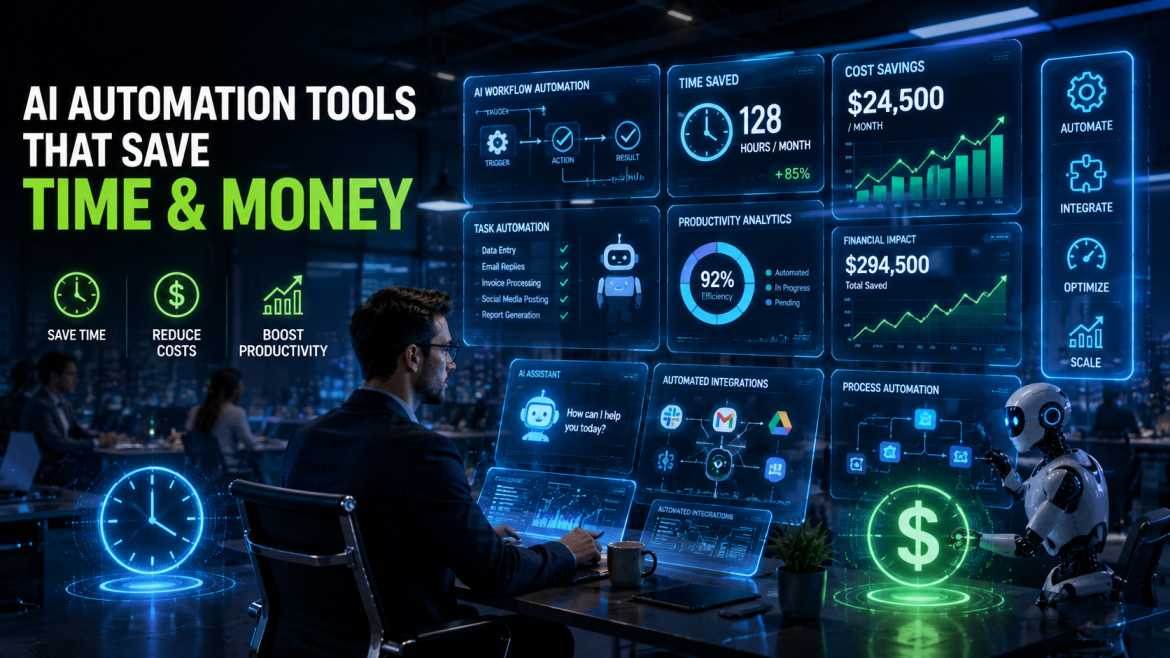
Artificial intelligence is transforming the way businesses operate. In 2026, companies are no longer using AI only for advanced technology projects or futuristic experiments. Instead, AI automation tools have become part of daily business operations across industries such as marketing, e-commerce, customer service, finance, healthcare, and content creation.
Businesses today face constant pressure to work faster, reduce operational costs, and remain competitive in a rapidly changing digital economy. This is where AI automation tools are making the biggest impact. These platforms help businesses automate repetitive tasks, improve productivity, reduce human error, and save valuable time.
From scheduling emails and managing customer support to generating content and analyzing data, AI-powered automation is helping businesses complete tasks in minutes that once required hours of manual work.
One of the biggest advantages of AI automation is scalability. Small startups can now perform tasks that previously required large teams and expensive software systems. Entrepreneurs, freelancers, and online businesses are increasingly using automation to grow faster while keeping expenses under control.
In this article, we will explore the best AI automation tools that save time and money, how businesses are using them, and why automation is becoming one of the most important trends in modern business operations.
Why AI Automation Is Growing So Fast
The rise of AI automation is largely driven by the need for efficiency. Businesses want to reduce repetitive work so employees can focus on higher-value tasks such as strategy, creativity, and customer relationships.
Major Reasons Businesses Use AI Automation
1. Time Savings
Automation reduces the amount of manual work required for daily operations.
Tasks like:
- Sending emails
- Organizing data
- Scheduling posts
- Generating reports
- Responding to customers
can now be handled automatically.
2. Reduced Costs
Hiring large teams can be expensive. AI automation tools allow businesses to operate with fewer employees while maintaining productivity.
This is especially valuable for:
- Startups
- Small businesses
- Freelancers
- Online entrepreneurs
3. Improved Accuracy
Humans can make mistakes during repetitive tasks, especially when dealing with large amounts of data.
AI systems improve consistency and reduce operational errors.
4. Better Productivity
Employees can focus on creative and strategic work instead of repetitive administrative tasks.
This often improves overall business performance.
1. Zapier AI Automation Platform
Zapier is one of the most widely used automation platforms in the world.
It connects different apps and automates workflows without requiring coding knowledge.
What Businesses Use It For
Businesses automate tasks such as:
- Email notifications
- CRM updates
- Lead management
- Social media posting
- File organization
For example, when a customer submits a contact form, Zapier can automatically:
- Add the lead to a CRM
- Send an email response
- Notify the sales team
- Create a task in a project management app
All of this happens instantly without human involvement.
Why It Saves Time
Instead of manually transferring information between apps, workflows run automatically in the background.
Best For
- Small businesses
- Marketing agencies
- Online stores
- Freelancers
2. OpenAI ChatGPT
ChatGPT is no longer just a chatbot. Businesses now use it as a powerful automation assistant for writing, research, coding, brainstorming, and customer communication.
How Companies Automate Work Using ChatGPT
Content Creation
Businesses generate:
- Blog posts
- Emails
- Ad copy
- Product descriptions
- Social media captions
Customer Support
AI systems handle common customer questions instantly.
Research and Analysis
Teams summarize reports and extract insights quickly.
Why Businesses Use It
Content creation and communication are time-consuming. ChatGPT significantly speeds up these processes.
Main Benefits
- Faster workflow
- Reduced writing costs
- Increased productivity
- Better customer response times
3. HubSpot AI CRM Automation
Customer relationship management becomes more difficult as businesses grow.
HubSpot uses AI automation for:
- Email marketing
- Customer follow-ups
- Lead scoring
- Chatbots
- Sales automation
How It Saves Money
Businesses can manage customer communication with smaller sales teams.
AI also improves marketing efficiency by targeting the right customers automatically.
Features Businesses Love
- Automated email campaigns
- AI customer segmentation
- Smart lead prioritization
- Workflow automation
Best For
- Sales teams
- SaaS businesses
- E-commerce stores
- Marketing agencies
4. Shopify AI E-Commerce Automation
Running an online store involves many repetitive tasks.
Shopify’s AI tools help automate:
- Inventory management
- Product descriptions
- Customer support
- Personalized recommendations
- Order tracking
Why E-Commerce Businesses Need Automation
Online stores handle large numbers of products and customer interactions daily.
AI reduces manual workload while improving customer experience.
Major Benefits
- Faster store management
- Better customer engagement
- Improved sales conversions
- Reduced support costs
5. Canva Magic Studio
Visual content creation can consume a huge amount of time for businesses.
Canva Magic Studio automates many design tasks using AI.
Businesses Use It For
- Social media graphics
- Marketing materials
- Presentations
- YouTube thumbnails
- Ad creatives
Why It Saves Time
Even non-designers can create professional visuals quickly without hiring expensive design teams.
Cost Benefits
Businesses reduce spending on:
- Freelance designers
- Stock graphics
- Editing software
6. Notion Notion AI
Notion AI helps businesses organize workflows, documents, and team collaboration.
Common Automation Features
- Meeting summaries
- AI-generated notes
- Task organization
- Documentation assistance
- Workflow management
Why Teams Use It
Instead of manually organizing information, AI helps structure tasks and summarize key points automatically.
Main Benefits
- Better organization
- Faster documentation
- Improved team productivity
7. Microsoft Copilot
Microsoft Copilot integrates AI directly into Office tools such as Word, Excel, PowerPoint, Teams, and Outlook.
Businesses Use It For
- Spreadsheet analysis
- Presentation generation
- Email drafting
- Meeting summaries
- Data visualization
Why It’s Valuable
Office work often involves repetitive tasks that consume hours every week.
Copilot automates much of this work.
Major Advantages
- Faster reporting
- Improved office productivity
- Better data analysis
- Reduced administrative workload
8. Google Gemini Workspace AI
Google Gemini helps automate workflows inside Gmail, Docs, Sheets, and Meet.
Popular Features
- Smart email writing
- AI meeting notes
- Document generation
- Spreadsheet insights
- Workflow assistance
Why Businesses Like It
Many companies already use Google Workspace, making AI integration easy.
Best For
- Remote teams
- Freelancers
- Consultants
- Agencies
9. Salesforce Einstein AI
Large businesses often manage huge amounts of customer data.
Salesforce Einstein AI automates:
- Sales forecasting
- Customer insights
- Workflow management
- Predictive analytics
Why Enterprise Businesses Use It
Data analysis that once required entire departments can now be automated using AI systems.
Key Benefits
- Smarter decision-making
- Improved customer targeting
- Increased sales efficiency
10. Runway AI Video Automation
Video marketing is extremely important in 2026, but editing videos manually takes time.
Runway automates:
- Video editing
- Background removal
- AI effects
- Caption generation
- Scene editing
Why Creators Use It
Businesses and content creators can produce videos faster with smaller teams.
Best For
- YouTubers
- Marketing agencies
- Social media creators
- Brands
Industries Benefiting Most From AI Automation
AI automation is affecting nearly every industry, but some sectors benefit more than others.
Marketing and Advertising
Marketing teams automate:
- Email campaigns
- Social media posts
- Ad optimization
- Analytics reporting
This reduces manual workload significantly.
E-Commerce
Online stores automate:
- Inventory tracking
- Customer support
- Product recommendations
- Sales analysis
AI helps improve customer experience while reducing costs.
Customer Support
AI chatbots now handle millions of customer interactions daily.
Businesses save money while improving response times.
Finance and Accounting
Automation tools assist with:
- Expense tracking
- Invoice generation
- Fraud detection
- Financial reporting
This improves accuracy and efficiency.
Content Creation
AI writing and design tools speed up:
- Blogging
- Video production
- Graphic design
- Social media management
Businesses can create more content with smaller teams.
How AI Automation Saves Businesses Money
Many businesses adopt AI because of financial benefits.
Lower Labor Costs
Automation reduces the need for large administrative teams.
Faster Operations
Businesses complete tasks more efficiently, increasing productivity.
Fewer Errors
Mistakes can be expensive. AI systems improve consistency.
Better Resource Allocation
Employees focus on high-value tasks rather than repetitive work.
Challenges of AI Automation
Although AI offers major benefits, businesses still face challenges.
Initial Learning Curve
Teams may need training to use AI tools effectively.
Overdependence on Automation
Businesses relying entirely on automation may lose human connection and creativity.
Privacy and Security Concerns
Companies handling sensitive data must ensure AI tools follow proper security standards.
Job Displacement Concerns
Automation may reduce demand for certain repetitive roles.
Businesses must balance efficiency with workforce responsibility.
The Human Side of Automation
Despite rapid AI growth, human skills remain extremely valuable.
AI handles repetitive tasks well, but humans still lead in:
- Creativity
- Emotional intelligence
- Leadership
- Strategy
- Relationship-building
The most successful businesses combine AI efficiency with human expertise.
The Future of AI Automation
AI automation is expected to become even more advanced over the next few years.
Future systems may include:
- Fully automated customer service
- AI-powered virtual employees
- Predictive business management
- Real-time workflow optimization
- Personalized AI assistants
Businesses adopting automation early may gain a major competitive advantage.
Choosing the Right AI Automation Tool
The best automation platform depends on business needs.
For Marketing
- HubSpot
- Canva
- ChatGPT
For Productivity
- Notion AI
- Microsoft Copilot
- Gemini
For E-Commerce
- Shopify AI
- Zapier
For Enterprise Analytics
- Salesforce Einstein AI
Final Thoughts
AI automation tools are changing the modern business world by helping companies save time, reduce costs, and improve productivity.
Platforms like Zapier, OpenAI ChatGPT, HubSpot, Shopify AI tools, and Microsoft Copilot are becoming essential for businesses of every size.
While automation cannot replace all human skills, it is dramatically improving efficiency across industries. Businesses that learn how to combine AI automation with human creativity and strategic thinking will likely dominate the future digital economy.
As technology continues evolving, AI automation will become even more integrated into everyday business operations, making work faster, smarter, and more scalable than ever before.