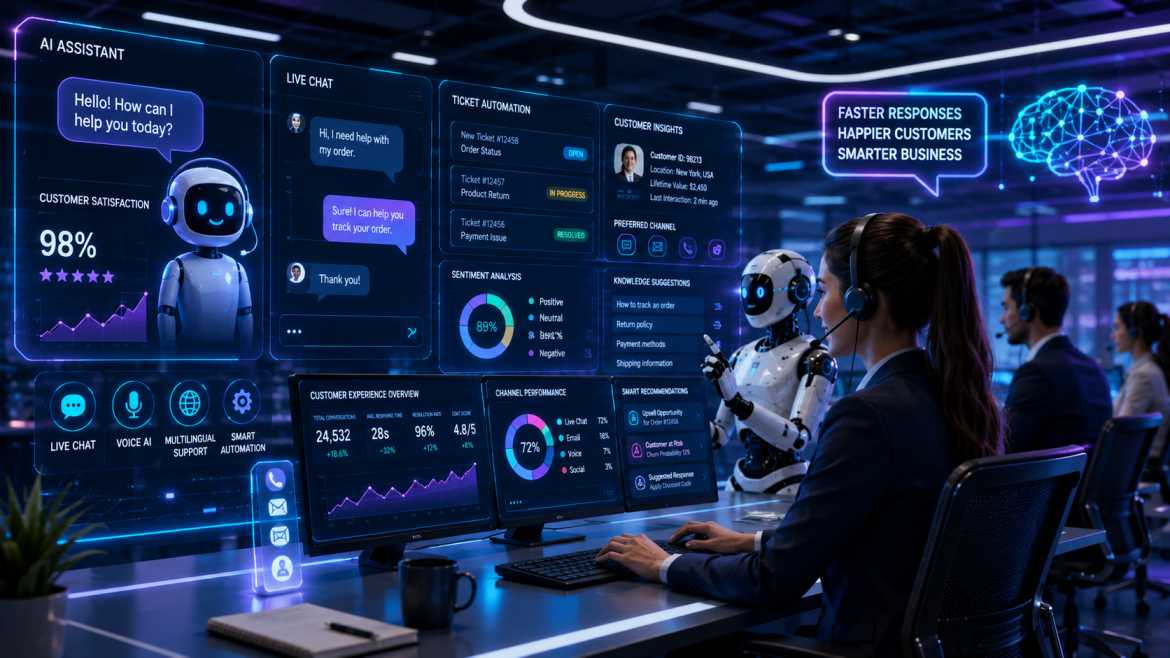
Customer service has always been one of the most important parts of any business. No matter how good a product or service may be, customers expect fast responses, personalized support, and smooth communication. In today’s digital world, people no longer want to wait hours or days for assistance. They expect immediate solutions, 24/7 availability, and better experiences across every platform.
This growing demand for speed and convenience is one of the main reasons artificial intelligence has become such a powerful force in customer service.
In 2026, AI is transforming how businesses communicate with customers. Companies across industries including e-commerce, banking, healthcare, travel, telecommunications, and software services are using AI-powered tools to improve support systems, reduce response times, and lower operational costs.
What makes AI especially valuable in customer service is its ability to handle repetitive tasks automatically while still providing personalized experiences. Modern AI systems can understand natural language, analyze customer behavior, predict problems, and even respond in a conversational manner that feels increasingly human.
At the same time, AI is changing the role of customer service employees. Instead of replacing all human workers, many businesses are using AI to assist support teams and improve efficiency. Human agents now focus more on complex problems, emotional communication, and relationship-building while AI handles routine interactions.
In this article, we will explore how AI is transforming customer service, the technologies businesses are using, the benefits and challenges of AI support systems, and what the future of customer experience may look like in the coming years.
The Evolution of Customer Service
Customer service has changed dramatically over the past few decades.
Years ago, support was mostly handled through:
- Phone calls
- Physical offices
- Email communication
Customers often waited long periods to receive help.
As the internet expanded, businesses introduced:
- Live chat systems
- Social media support
- Self-service knowledge bases
Today, AI-powered systems are taking customer service to an entirely new level.
Modern AI tools can:
- Respond instantly
- Handle thousands of conversations simultaneously
- Personalize communication
- Predict customer needs
- Automate repetitive support tasks
This transformation is helping businesses deliver faster and more efficient customer experiences than ever before.
Why Businesses Are Adopting AI in Customer Service
Companies are investing heavily in AI because customer support has become more demanding and expensive.
1. Customers Expect Instant Responses
People no longer want to wait on hold for long periods or wait days for email replies.
AI-powered chatbots and virtual assistants provide immediate responses at any time of day.
2. Rising Support Costs
Hiring and training large customer support teams can be expensive.
AI helps businesses reduce operational costs by automating repetitive interactions.
3. Growing Customer Volumes
As businesses grow, customer inquiries increase rapidly.
AI systems can handle large volumes of conversations simultaneously without reducing speed.
4. Need for Personalization
Modern customers expect personalized experiences.
AI analyzes customer behavior and preferences to provide more relevant support.
AI Chatbots: The Biggest Transformation
One of the most visible examples of AI in customer service is the rise of chatbots.
Unlike older automated systems that relied on fixed scripts, modern AI chatbots use natural language processing to understand customer questions more accurately.
These systems can:
- Answer FAQs
- Process orders
- Handle refunds
- Provide product recommendations
- Schedule appointments
- Troubleshoot basic issues
Why Businesses Use Chatbots
AI chatbots provide:
- 24/7 availability
- Instant responses
- Reduced support workload
- Consistent communication
Real-World Examples
E-commerce stores use chatbots to answer shipping questions.
Banks use AI assistants to help customers check balances and manage accounts.
Telecom companies automate troubleshooting processes using conversational AI.
Personalized Customer Experiences
One of AI’s greatest strengths is personalization.
Modern AI systems analyze:
- Purchase history
- Browsing behavior
- Customer preferences
- Previous support interactions
Using this information, businesses can provide highly customized experiences.
Examples of Personalization
E-Commerce
AI recommends products based on customer behavior.
Streaming Platforms
AI suggests movies and shows tailored to user interests.
Banking
AI systems offer financial recommendations based on spending patterns.
Customer Support
AI agents recognize returning customers and provide context-aware assistance.
Personalization improves customer satisfaction because people feel understood and valued.
AI-Powered Voice Assistants
Voice-based AI systems are also becoming more common in customer service.
Businesses use voice AI for:
- Phone support automation
- Appointment scheduling
- Order tracking
- Technical troubleshooting
Modern voice assistants sound more natural than older automated phone systems.
Benefits of Voice AI
- Faster support handling
- Reduced call center workload
- Improved accessibility
- 24/7 customer support
Some businesses now use AI voice agents capable of handling entire customer conversations without human involvement.
AI and Customer Support Teams
Many people worry that AI will completely replace customer service workers. In reality, most businesses are using AI to assist support teams rather than eliminate them entirely.
How AI Helps Human Agents
AI systems can:
- Suggest responses
- Summarize conversations
- Retrieve customer history
- Detect customer sentiment
- Recommend solutions
This allows human agents to resolve problems more efficiently.
The Human Advantage
Humans still perform better in situations requiring:
- Empathy
- Emotional intelligence
- Complex decision-making
- Relationship-building
AI handles repetitive tasks while humans focus on more sensitive or complicated issues.
Faster Problem Resolution
One of the biggest improvements AI brings to customer service is speed.
Traditional support systems often involve:
- Long wait times
- Multiple transfers
- Repeated explanations
AI systems reduce these frustrations by:
- Instantly accessing information
- Routing customers correctly
- Automating repetitive tasks
Example
If a customer contacts an online store about a delayed order, AI can instantly:
- Verify the order
- Track shipping status
- Provide updates
- Offer refund options
Without requiring multiple human interactions.
AI Sentiment Analysis
Modern AI systems can analyze customer emotions during conversations.
This technology is called sentiment analysis.
AI detects:
- Frustration
- Satisfaction
- Anger
- Urgency
Businesses use this information to prioritize customer interactions.
Why It Matters
If AI detects a highly frustrated customer, the system may immediately transfer the case to a senior support agent.
This improves customer retention and reduces negative experiences.
AI Self-Service Systems
Many customers prefer solving problems themselves instead of contacting support teams.
AI-powered self-service tools include:
- Smart FAQs
- Interactive help centers
- AI search systems
- Troubleshooting assistants
These systems help customers find answers quickly without waiting for human support.
Benefits for Businesses
- Reduced support tickets
- Lower staffing costs
- Faster issue resolution
Industries Being Transformed by AI Customer Service
AI support systems are affecting almost every industry.
E-Commerce
Online stores use AI for:
- Chatbots
- Product recommendations
- Automated returns
- Order tracking
AI improves both customer experience and sales conversions.
Banking and Finance
Banks use AI for:
- Fraud alerts
- Customer inquiries
- Financial recommendations
- Account management
AI reduces operational costs while improving security and convenience.
Healthcare
Healthcare organizations use AI to:
- Schedule appointments
- Answer patient questions
- Provide reminders
- Assist with medical inquiries
This improves efficiency while reducing administrative workload.
Travel and Hospitality
Hotels and airlines use AI for:
- Booking assistance
- Travel recommendations
- Customer support
- Flight updates
AI helps businesses provide faster service to travelers worldwide.
Telecommunications
Telecom companies use AI to:
- Troubleshoot internet issues
- Handle billing inquiries
- Manage account support
This reduces pressure on call centers significantly.
Benefits of AI in Customer Service
AI offers several major advantages for businesses and customers.
1. 24/7 Availability
Customers can receive assistance at any time, even outside business hours.
2. Reduced Costs
Businesses lower staffing expenses through automation.
3. Faster Responses
AI systems provide immediate support.
4. Improved Customer Satisfaction
Faster and more personalized experiences improve customer loyalty.
5. Better Scalability
AI handles large volumes of customer interactions simultaneously.
Challenges of AI Customer Service
Despite its advantages, AI customer service also has limitations.
Lack of Human Emotion
AI still struggles with emotional understanding compared to human agents.
Customers dealing with sensitive issues often prefer speaking with real people.
Complex Problems
AI systems may fail when handling highly unusual or complicated situations.
Human intervention remains important for advanced support cases.
Privacy Concerns
Businesses must ensure customer data is handled securely.
AI systems often process large amounts of personal information.
Overautomation Risks
Some companies rely too heavily on automation, creating frustrating customer experiences.
Poorly designed AI systems can make support feel impersonal.
The Future of AI in Customer Service
AI customer service technology is expected to become even more advanced over the next few years.
Future developments may include:
- More human-like AI conversations
- Real-time language translation
- Predictive customer support
- Fully autonomous AI agents
- Hyper-personalized experiences
Businesses will likely continue blending AI automation with human support teams.
Human Jobs and the AI Era
Although AI is automating many support tasks, customer service jobs are not disappearing entirely.
Instead, roles are evolving.
Future customer service workers may focus more on:
- Relationship management
- High-level problem solving
- Emotional support
- Customer retention strategies
AI will likely become a support tool rather than a complete replacement for human interaction.
How Businesses Can Use AI Successfully
Companies implementing AI should focus on balance.
Best Practices
- Use AI for repetitive tasks
- Keep human support available
- Prioritize customer experience
- Train employees to work with AI
- Protect customer data
Businesses that combine automation with genuine human service usually achieve the best results.
Final Thoughts
Artificial intelligence is transforming customer service faster than ever before. Businesses across industries are using AI-powered chatbots, automation systems, voice assistants, and analytics tools to improve customer experiences while reducing costs and increasing efficiency.
AI allows companies to provide faster responses, personalized communication, and 24/7 support at a scale that would be difficult using traditional methods alone.
However, human interaction still remains extremely important. Customers continue to value empathy, trust, and emotional understanding — qualities that AI cannot fully replicate.
The future of customer service will likely involve collaboration between humans and AI, where automation handles repetitive work while human agents focus on meaningful customer relationships and complex problem-solving.
Businesses that successfully combine AI technology with human-centered service will likely lead the next generation of customer experience innovation.