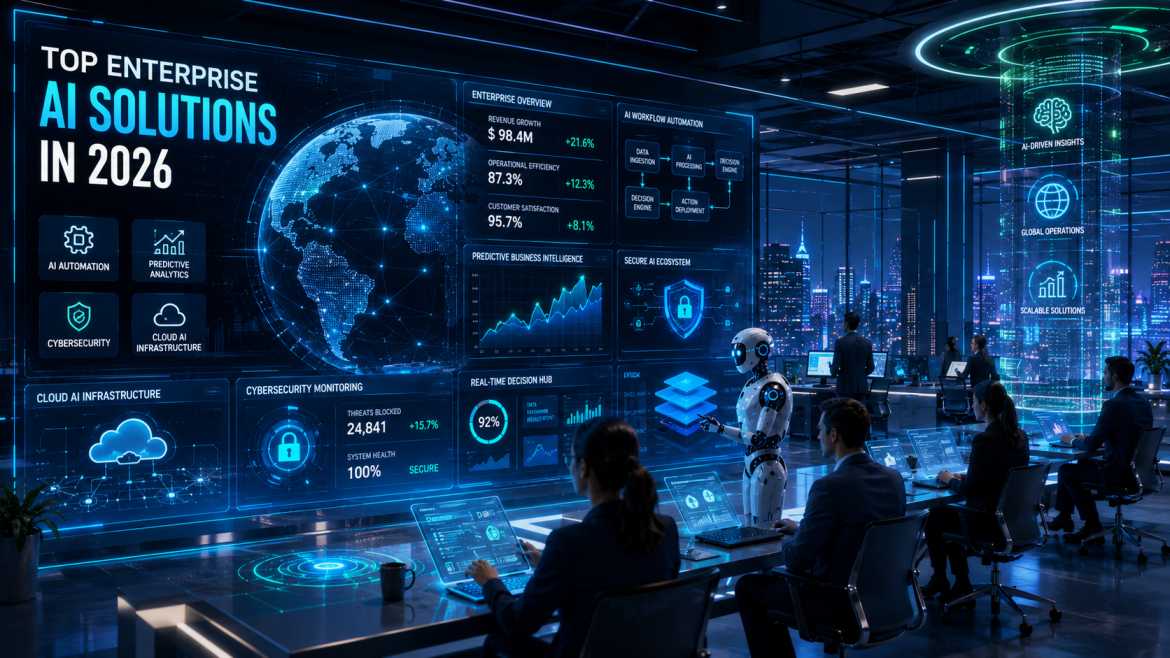
Artificial intelligence has moved far beyond simple chatbots and automation tools. In 2026, enterprise AI solutions are transforming how large organizations operate, make decisions, manage employees, serve customers, and compete in the global economy.
Companies today are dealing with enormous amounts of data, rising operational costs, cybersecurity threats, and increasing customer expectations. Traditional software systems are no longer enough to handle the speed and complexity of modern business operations. This is why enterprise AI adoption has accelerated across industries such as finance, healthcare, manufacturing, retail, logistics, and technology.
Enterprise AI solutions are designed specifically for large-scale organizations. Unlike basic AI apps used by individuals, enterprise platforms focus on security, scalability, compliance, workflow integration, analytics, and automation across thousands of employees and systems.
One of the biggest trends in 2026 is the rise of “AI agents” and intelligent copilots capable of handling complex business workflows. Major technology companies are competing aggressively to build enterprise-grade AI ecosystems that integrate with productivity tools, cloud infrastructure, customer data, and automation platforms.
In this article, we will explore the top enterprise AI solutions in 2026, how businesses are using them, and why enterprise AI is becoming one of the most important investments for modern organizations.
Why Enterprise AI Is Growing Rapidly
Businesses are investing heavily in AI because it offers measurable advantages in productivity, efficiency, automation, and decision-making.
Global AI spending is expected to grow significantly over the next few years as more companies integrate AI into daily operations.
Major Reasons Enterprises Use AI
Faster Operations
AI systems automate repetitive workflows and reduce manual labor.
Better Decision-Making
AI analyzes large datasets quickly and identifies patterns humans may miss.
Lower Costs
Automation reduces operational expenses and improves efficiency.
Improved Customer Experience
AI-powered personalization and customer support improve satisfaction.
Competitive Advantage
Businesses using AI effectively often innovate faster than competitors.
1. Microsoft Copilot and Azure AI
Microsoft remains one of the biggest players in enterprise AI in 2026.
Its AI ecosystem combines:
- Microsoft 365 Copilot
- Azure AI services
- Power Platform automation
- AI agents
- Enterprise security tools
Microsoft’s deep integration across Word, Excel, Outlook, Teams, SharePoint, and Dynamics makes Copilot especially attractive for enterprises already operating inside the Microsoft ecosystem.
Key Features
- AI meeting summaries
- Spreadsheet analysis
- Automated presentations
- Workflow automation
- AI agents for enterprise tasks
Why Enterprises Use It
Most large companies already rely on Microsoft software. Copilot allows businesses to add AI capabilities without changing their entire infrastructure.
Main Advantages
- Strong security and compliance
- Enterprise-grade scalability
- Deep productivity integration
- AI-powered workflow automation
Best For
- Large enterprises
- Financial institutions
- Corporate office environments
- Global organizations
2. Google Vertex AI and Gemini Enterprise
Google has become one of the strongest competitors in enterprise AI through Vertex AI and Gemini Enterprise.
Google’s enterprise ecosystem focuses heavily on:
- Machine learning
- AI model deployment
- Large-scale analytics
- AI agents
- Workspace integration
According to industry comparisons, Google Vertex AI is widely recognized for strong AutoML capabilities and access to Gemini models.
Key Features
- Gemini AI integration
- AI agent builder
- AutoML systems
- Advanced data analytics
- Enterprise search capabilities
Why Businesses Choose Google
Google’s cloud infrastructure and AI research leadership make it attractive for companies building advanced AI systems.
Major Benefits
- Strong AI research ecosystem
- Scalable cloud infrastructure
- Powerful multimodal AI
- Excellent data processing
Best For
- Technology companies
- Data-heavy enterprises
- Research organizations
- AI-focused startups
3. Amazon AWS SageMaker and Bedrock
Amazon Web Services remains a dominant force in enterprise cloud computing and AI infrastructure.
AWS provides businesses with:
- SageMaker for machine learning
- Bedrock for generative AI
- AI model hosting
- Enterprise automation tools
AWS is especially popular among enterprises needing flexible cloud architecture and custom AI deployment.
Why Enterprises Use AWS
Many global businesses already run their infrastructure on AWS. Integrating AI services into existing systems becomes easier.
Main Features
- Model training and deployment
- Custom AI infrastructure
- Generative AI integrations
- Enterprise-scale cloud computing
Advantages
- Flexible architecture
- Massive scalability
- Strong developer ecosystem
- Enterprise-grade reliability
4. Salesforce Einstein AI and Agentforce
Salesforce continues to dominate customer relationship management, and its AI ecosystem has become significantly more advanced in 2026.
Salesforce AI focuses on:
- Customer intelligence
- Predictive analytics
- AI-powered sales automation
- Customer support agents
- CRM workflow automation
The company’s Agentforce platform is now used by thousands of businesses to automate customer interactions and enterprise workflows.
Key Benefits
- Better customer targeting
- Automated sales workflows
- AI-driven analytics
- Improved customer service
Why Enterprises Use It
Salesforce integrates AI directly into customer management systems, making it highly valuable for sales-focused organizations.
Best For
- Sales organizations
- Marketing teams
- SaaS companies
- Customer-focused enterprises
5. IBM watsonx
IBM watsonx has become one of the leading enterprise AI platforms for regulated industries.
The platform emphasizes:
- AI governance
- Compliance
- Data security
- Hybrid cloud AI
- Enterprise analytics
Industry comparisons consistently highlight IBM’s strong governance features for sectors such as healthcare, banking, and government operations.
Why Enterprises Trust IBM
Large organizations handling sensitive data require strict compliance and security standards.
Main Advantages
- Strong governance controls
- Enterprise-grade security
- Compliance-focused AI
- Hybrid infrastructure support
Best For
- Healthcare organizations
- Financial institutions
- Government agencies
- Regulated industries
6. SAP Business AI
SAP is integrating AI deeply into enterprise resource planning and operational management systems.
SAP’s latest AI initiatives focus on:
- Finance automation
- HR management
- Procurement optimization
- Supply chain automation
- Enterprise workflows
Recent developments show SAP aggressively expanding AI automation across enterprise operations through its Autonomous Enterprise platform.
Why Enterprises Use SAP AI
Large enterprises already using SAP ERP systems can integrate AI into operations more smoothly.
Major Benefits
- Workflow automation
- Operational efficiency
- Enterprise data integration
- AI-powered business management
7. ServiceNow AI Workflow Automation
ServiceNow has become one of the leading enterprise workflow automation platforms.
Its AI solutions focus heavily on:
- IT operations
- Employee workflows
- Customer service
- Process automation
- Enterprise service management
Industry reports indicate rapid growth in ServiceNow’s enterprise AI business.
Why Businesses Use It
Large organizations often struggle with complex internal workflows. ServiceNow automates these systems efficiently.
Best Features
- AI ticket resolution
- Workflow automation
- IT service management
- Employee support systems
8. Databricks Mosaic AI
Databricks has emerged as a major enterprise AI platform due to its strong focus on data and AI integration.
Mosaic AI helps enterprises:
- Build AI applications
- Train custom models
- Analyze large datasets
- Deploy AI workflows
Why Enterprises Use Databricks
Many businesses struggle with fragmented data systems. Databricks helps unify analytics and AI infrastructure.
Main Benefits
- Strong data management
- Scalable AI workflows
- Advanced analytics
- AI application development
9. Palantir Technologies Artificial Intelligence Platform (AIP)
Palantir has become a major player in enterprise and government AI systems.
Its AI platform focuses on:
- Mission-critical operations
- Defense analytics
- Industrial automation
- Secure AI deployment
Why Organizations Use It
Palantir specializes in highly secure and operationally complex environments.
Best For
- Government agencies
- Defense organizations
- Manufacturing
- Logistics companies
10. OpenAI ChatGPT Enterprise
ChatGPT Enterprise has become one of the most widely adopted AI assistants for businesses.
Organizations use it for:
- Writing
- Research
- Coding
- Workflow automation
- Customer support
- Internal knowledge systems
Enterprise AI strategies increasingly involve multi-model environments using platforms such as GPT, Gemini, and Claude together.
Why Businesses Use It
ChatGPT Enterprise provides powerful reasoning and productivity capabilities with enterprise-level security.
Main Benefits
- Fast knowledge access
- AI-assisted productivity
- Workflow support
- Team collaboration
Major Enterprise AI Trends in 2026
Enterprise AI is evolving rapidly, and several major trends are shaping the market.
Multi-Model AI Strategies
Many enterprises now use multiple AI models instead of relying on a single provider.
This allows businesses to:
- Reduce dependency risks
- Optimize costs
- Improve performance for different tasks
AI Agents and Autonomous Workflows
AI agents capable of handling complex multi-step tasks are becoming increasingly important.
These systems can:
- Analyze documents
- Update databases
- Manage workflows
- Coordinate business tasks
AI Governance and Security
Businesses are focusing heavily on:
- Data privacy
- Compliance
- Audit trails
- Zero-data retention systems
Enterprise AI adoption depends heavily on trust and security.
AI-Powered Enterprise Search
Companies are increasingly using AI to search across internal documents, emails, cloud systems, and databases.
Challenges Enterprises Face With AI
Despite rapid adoption, enterprise AI still faces several challenges.
Integration Complexity
Large organizations often use many legacy systems that are difficult to connect with modern AI platforms.
Cost
Enterprise AI implementation can require significant infrastructure investment.
Security Risks
Handling sensitive company and customer data requires strong governance.
Workforce Adaptation
Employees need training to work effectively with AI systems.
The Future of Enterprise AI
Enterprise AI is expected to become even more advanced over the next few years.
Future systems may include:
- Fully autonomous enterprise agents
- Real-time predictive business management
- AI-driven executive decision support
- Personalized enterprise assistants
- Advanced multimodal AI systems
Organizations that adopt AI strategically may gain significant long-term advantages in productivity, innovation, and operational efficiency.
Final Thoughts
Enterprise AI solutions are transforming how businesses operate in 2026. Large organizations are using AI to automate workflows, improve productivity, enhance customer experiences, and make smarter decisions faster.
Platforms like Microsoft Copilot, Google Vertex AI, Amazon AWS SageMaker, Salesforce Einstein AI, and IBM watsonx are leading the enterprise AI revolution.
As AI technology continues evolving, businesses that successfully combine automation, analytics, governance, and human expertise will likely dominate the next generation of the global digital economy.